Posts

Malacology - An introduction to Mollusca, its characteristics, morphology, family, history, ecology and fossil record

Image
Malacology Chitons, clams, mussels, snails, sea slugs, tusk shells, octopus, and squid are among the mollusks studied in malacology. Mollusks can be found practically anywhere, including on the rocky shore, in freshwater settings, and in your own backyard. Characteristics Molluscs have the following characteristics: a soft, unsegmented body with a muscular foot or tentacles and a mantle capable of secreting a shell. Mollusks in general, but not all, have: a radula is an interior or external shell (tongue with teeth). Introduction With at least 50,000 live species, mollusks are one of the most diverse animal groupings on the world (and more likely around 200,000). Snails, octopuses, squid, clams, scallops, oysters, and chitons are among the species found there. Mollusca also includes several lesser-known families, such as the monoplacophorans, which were assumed to be extinct for millions of years until a specimen was discovered in the deep water off the coast of Costa Rica in...

Lunar Water - Evidence of Ice at the South Pole of the Moon

Image
Lunar water may be more accessible than previously assumed, according to new Moon observations. The new information is especially interesting for NASA, which intends to use the Moon's resources particularly water ice embedded in the soil to aid future astronauts in living and working on the lunar surface. Researchers discovered water directly on the lunar surface in one investigation, discovering the molecule on portions of the Moon that were lit by the Sun. According to a second study, water ice could be stored in tiny pockets or small craters strewn across the Moon's surface, making water possibly more abundant and accessible than we could have thought. Both studies were published in the journal Nature today. It's not the first time that water has been discovered on the Moon. However, the only water we've been able to locate and verify thus far is quite difficult to access. It appears to be mostly found in perpetually shadowed huge craters at the lunar South Pole....

Gas Hydrates recovery methods, issues and solution for its prevention

Image
Recovery of Gas Hydrates We can recover gas hydrates through various methods; Thermal Stimulation Method. Depressurization Method. Inhibitor Injection Method. Carbon Dioxide Injection Method. Thermal Stimulation Method The thermal stimulation approach involves raising the hydrate temperature above the stability point, causing the hydrate to dissociate. Thermal stimulation requires a continuous energy source to overcome the endothermic heat of dissociation. Figure 1 Thermal injection method. Depressurization Method Depressurization involves lowering the hydrate pressure below the stability point, causing the hydrate to dissociate. Depressurization results in rapid hydrate dissociation, but with an associate drop in the hydrate temperature. Without an external heat source, depressurization lowers the hydrate temperature to a new equilibrium condition, halting the depressurization process. Figure 2 Depressurization method. Disadvantages There are the following dis...

Facts about Atacama Desert, South America - A resemblance to Mars

Image
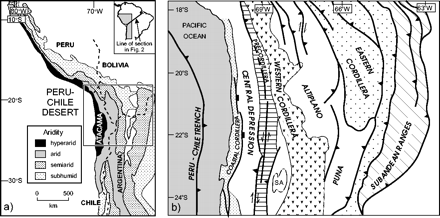
Chile's Atacama Desert, which stretches from the Pacific Ocean to the Andes Mountains, is a sparsely populated, almost rainless plateau. It is less than 100 miles wide on average, yet it stretches 600 miles south of the Peruvian border. The Pacific Coastal Range, with an average elevation of 2500 feet, is the mountain range closest to the ocean. East of the Andes Mountains is the Cordillera Domeyko, a range of foothills. Salt basins (salars), sand, and lava flows make up the Atacama. The scenery is regarded as "moon-like" since it is so bleak. In reality, the Atacama Desert has been considered as a suitable location for testing a future lunar rover prototype. Figure 1  (a) Current climatic zones of western South America. SA stands for Salar de Atacama. (b) Morphotectonic subdivisions of the Central Andes. Geology & geochemistry The Atacama Desert, the world's driest, has a number of geological and geochemical characteristics that set it apart from any other habi...

An Introduction to Black Holes - A supermassive gravitational pull

Image
A black hole is an astronomical object with such a tremendous gravitational pull that nothing can escape it, not even light. The event horizon of a black hole is the boundary where the velocity required to escape exceeds the speed of light, which is the universe's speed limit. Matter and radiation are drawn in, yet they are unable to exit. There are two types of black holes that have been studied extensively. Super massive monsters weighing 100,000 to billions of solar masses are found in the centers of most big galaxies, including ours. Stellar-mass black holes with three to dozens of times the Sun's mass are found throughout our Milky Way galaxy, while super massive monsters weighing 100,000 to billions of solar masses are found in the centers of most big galaxies, including ours. The existence of an intermediate-mass black hole, weighing 100 to 10,000 solar masses, had long been suspected by astronomers. While a few candidates have been identified based on circumstantial...

Neptune Great Dark Spots

Image
Figure 1  A massive dark storm [top centre] and the emergence of a smaller dark spot nearby [top right] are visible in this Hubble Space Telescope image of the dynamic blue-green planet Neptune. Credits: NASA Neptune's weather is among the strangest in the solar system. The sun's eighth planet has the fastest winds of any planet, cutting through the atmosphere at speeds of up to 1,100 miles per hour, or 1.5 times the speed of sound. Scientists are still baffled as to why its atmosphere is so turbulent. Their most recent sighting of Neptune added to their confusion. In 2018, the Hubble Space Telescope discovered a storm with a diameter of 4,600 miles. According to the most recent Hubble observations, it appears to have drifted toward the equator but then swooped back up north. It also has a smaller companion storm, dubbed Dark Spot Jr., which scientists believe is a piece of the main storm that broke off. These inky vortexes stand out against the planet's dizzying cerulean...

Maat Mons - Highest Volcano on Venus

Image
Maat Mons is a massive shield volcano that erupts every few thousand years. On Venus, it is the planet's second-highest mountain, as well as its highest volcano. At 0.5°N 194.6°E, it rises 8 kilometers (5.0 miles) above the mean planetary radius and nearly 5 kilometers above the plains around it. Ma'at, the Egyptian goddess of truth and justice, is the inspiration for the name. Maat Mons has a large summit caldera with a diameter of 28×31 kilometers. There are at least five smaller collapse craters within the large caldera, each measuring up to 10 kilometers in diameter. A 40-kilometer-long chain of small craters measuring 3–5 km in diameter runs along the volcano's southeast flank, but instead of indicating a large fissure eruption, they appear to have been formed by collapse: full-resolution imagery from the Magellan probe shows no evidence of lava flows from these craters. On Maat Mons, at least two large-scale structural collapse events appear to have occurred in the ...